

Prioritizing environmental, social, and governance (ESG) issues can impact companies in many ways. According to TechTarget, ESG-based strategy is defined as an “organization-wide approach that adjusts a company’s environmental, social, and governance practices to increase business sustainability.”1
While many initially believed that ESG strategy would offer companies unconditional benefits, recent research shows this may not be the case. For example, while PwC’s “2024 Voice of the Consumer Survey” finds that 80% of respondents say they would pay more for sustainably produced or sourced goods,2 a recent University of Chicago study finds that respondents overstate their intentions: Actual purchases by respondents stating they prefer ESG products are no different than the general public’s purchases.3
Similarly, a Morgan Stanley survey finds that 77% of global investors are interested in sustainable investing.4 Yet, rigorous academic studies show that “funds investing in companies that publicly embrace ESG sacrifice financial returns without gaining much, if anything, in terms of actually furthering ESG interests.”5
The Stratonomics-B2BTM Study pursues the ESG question further, specifically measuring the opinions of energy industry insiders, including customers, employees, managers, executives, and vendors in the sector.
The research and its results provide oil and gas company leaders rare insight into the perspective of the industry stakeholders they rely on most to succeed.
In March 2024, the Stratonomics-B2BTM Study measured the degree to which energy industry insiders believe ESG is important to the sector and whether ESG-focused strategy and action benefit a company’s bottom line. The results are based on responses from 936 participants.
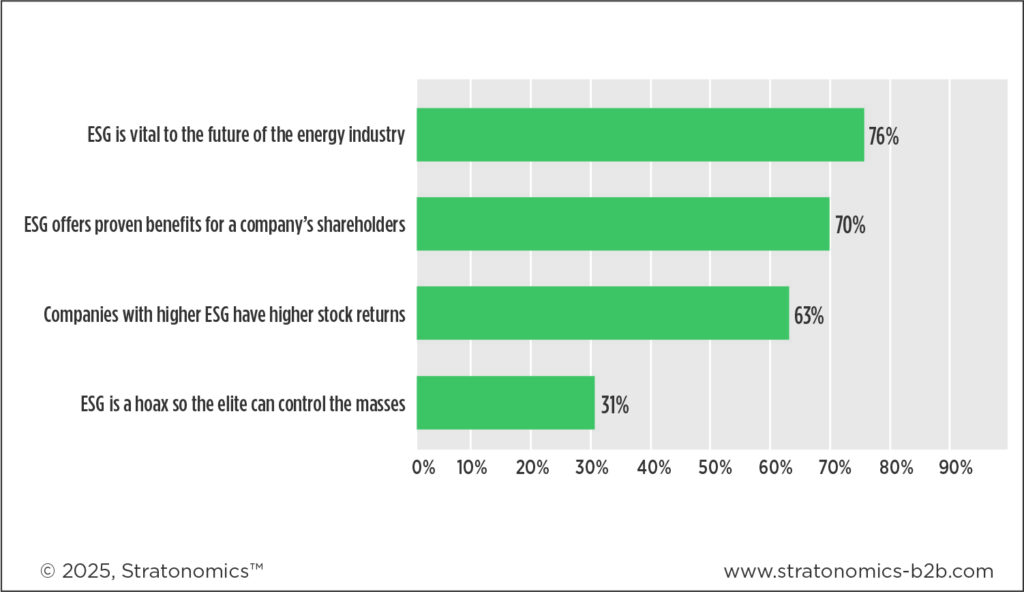
As shown in Figure 1:
• A large majority of energy-industry insiders (76%) agree that ESG is vital to the future of the energy industry, with seven out of 10 indicating the approach offers benefits to a company’s shareholders.
• More than half of respondents (63%) claim that a relatively high ESG commitment positively impacts a company’s bottom line in the form of elevated stock returns.
• About one third of respondents (31%) feel that “ESG is a hoax so the elite can control the masses.”
Insight from this report can help oil and gas companies build a multi-pronged strategy for further educating energy industry stakeholders about ESG strategies and be more proactive in addressing the issue.
Yasar, Kinza (2024), “5 ESG benefits for businesses,” TechTarget, August 7. https://www.techtarget.com/whatis/feature/5-ESG-benefits-for-businesses
PricewaterhouseCoopers (2024), “Consumers willing to pay 9.7% sustainability premium, even as cost-of-living and inflationary concerns weigh: PwC 2024
Voice of the Consumer Survey,” PWC.com, May 15. https://www.pwc.com/gx/en/news-room/press-releases/2024/pwc-2024-voice-of-consumer-survey.html
Merrick, Amy (2024), “Consumers Say They Care about ESG, but Don’t Spend Like They Do,” Chicago Booth Review, July 8. https://www.chicagobooth.edu/review/consumers-say-they-care-about-esg-but-dont-spend-like-they-do
Morgan Stanley Institute for Sustainable Investing (2024), “Sustainable Signals:
Understanding Individual Investors’ Interests and Priorities,” MorganStanley.com, January. https://www.morganstanley.com/content/dam/msdotcom/en/assets/pdfs/MSInstituteforSustainableInvesting-SustainableSignals-Individuals-2024.pdf
Bhagat, Sanjay (2022), “An Inconvenient Truth About ESG Investing,” Harvard Business Review, March 31. https://hbr.org/2022/03/an-inconvenient-truth-about-esg-investing